
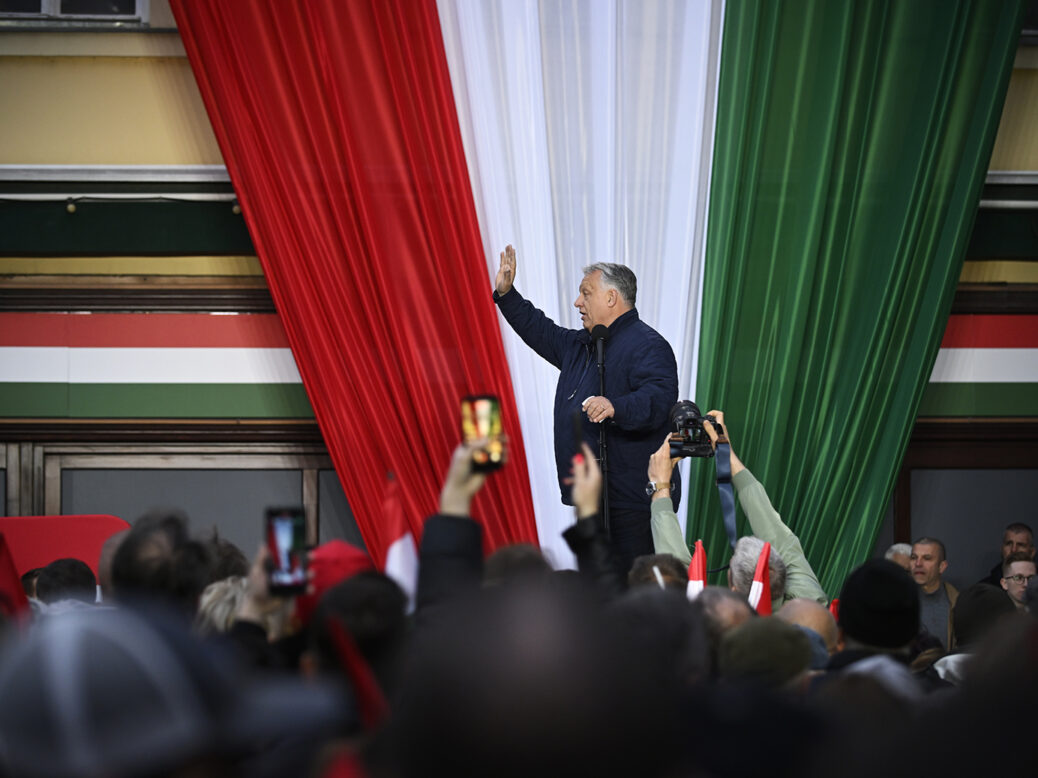
Viktor Orbán had been Hungarian prime minister since 2010. He was in power for four consecutive four-year terms, just like Angela Merkel, the German chancellor who was widely seen as his antagonist in the struggle between liberalism and illiberalism within the EU. In reality, until 2021, their parties were both part of the same grouping in the European Parliament, the European People’s Party (EPP). In that sense, they were political allies rather than opposites. But with Orbán’s defeat, five years after Merkel’s resignation, an era in Hungarian and European history has come to an end.
Orbán was, as Timothy Garton Ash put it recently, “the veto player in the European Union”. Although Orbán is gone, at least for the moment (in a recent interview with the New Statesman, Michael Ignatieff suggested that he could return to power at some point), it is unlikely that Hungary will suddenly become the compliant EU member state that many “pro-Europeans” hope it will. In any event, the European far right no longer sees Orbán as its leader – and no longer sees the EU as a straightforward enemy. It has evolved in the decade since the refugee crisis in 2015.
The new Hungarian prime minister, Péter Magyar, is often described as being “pro-European”. But he is a defector from Fidesz, Orbán’s party, which he only left two years ago to form his new party, Tisza. As the Italian legal scholar Alberto Alemanno puts it, Magyar is “a Fidesz insider, shaped by the same political culture, networks, and system that produced Orbán”. Moreover, his positions – for example on immigration – are not as far away from Orbán’s as is sometimes imagined. “He didn’t run against Orbánism,” Alemanno says. “He ran against Orbán.”
What prompted Magyar to leave Fidesz and start his own party in 2024 was the decision by the Hungarian president and Orbán ally, Katalin Novák, to pardon the deputy director of a children’s home who had been convicted of covering up sexual abuse. During the election campaign, the main way that Magyar sought to differentiate himself from Orbán was by opposing corruption. In that sense, Magyar is a little like the Maga figures – such as the Florida governor Ron DeSantis – who have promised to continue Trumpism without the chaos of Trump himself.

It is true that Orbán’s defeat will make it easier for the EU to support Ukraine, which is now the most urgent issue for many “pro-Europeans”. In particular, the election of Magyar clears the way for a €90bn loan to Ukraine that Orbán had been blocking – though Magyar wants Hungary to have an opt-out that would mean it would not have to contribute to it. But the country is likely to continue to be difficult on Ukraine: like Orbán, Magyar has said the EU should not fast-track Ukrainian accession to the bloc and he is also unlikely to stop buying the Russian gas on which Hungary still depends.
However, even if the departure of Orbán means that the EU can now support Ukraine more easily than it did while he was in power, this does not mean that the tide has turned against the European far right, as many will be tempted to imagine. Rather, the far right has evolved away from the Orbán model. Its paradigmatic figure is now Giorgia Meloni, Italy’s prime minister.
The theatrical battle between Merkel and Orbán at the time of the refugee crisis centred on the specific issue of mandatory quotas for relocating asylum seekers from one EU member state to another. She was in favour of such a “European solution” to the crisis, whereas Orbán saw it as a purely “German problem” that Merkel should solve on her own. (For several years, as the number of asylum seekers arriving in Greece and Italy increased, Merkel had also rejected the need for a European solution to the problem. It was only when Germany was overwhelmed by the numbers of asylum seekers arriving there in 2015 that she pivoted.)
Though Merkel and Orbán disagreed on what, in EU jargon, is referred to as the “secondary movements” of asylum seekers, they agreed on the need to stop the flow of migrants to the EU in the first place. Under pressure from the rise of the far right since 2015, the Union has taken a series of steps to prevent asylum seekers making it to the EU’s borders – even if that meant they drowned in the Mediterranean, as more than 30,000 have during the past decade – and to make it easier to deport them. Orbán rightly said that he won the argument in the EU.
The centre right has increasingly moved towards the far right in the last ten years – especially on issues around identity, immigration and Islam. That shift has turned the EU into Fortress Europe, which has allowed the far right to become increasingly open to working with it – and within it – instead of simply opposing it. Meloni, who became prime minister in 2022, embodies this realignment more than anyone else. Whereas Orbán had a fractious relationship with the EU – even while Fidesz remained in the EPP – hers is remarkably harmonious. Orbán’s election defeat might not be the end of the European far right, but the close of its performatively Eurosceptic phase.
[Further reading: Trump is not going to “chicken out” in Iran]
Content from our partners



Related



This article appears in the 15 Apr 2026 issue of the New Statesman, Angry Young Women
Join the debate
Subscribe here to comment